
Find Family Court Records in Yuma
Yuma family court records are managed by the Yuma County Superior Court. The city municipal court does not handle divorce, custody, or child support cases at all. If you need to find divorce filings, parenting time orders, or support records for a Yuma resident, you must go through the county court system. The Yuma County Clerk of Superior Court at 250 W. 2nd Street keeps all family law files for people living in Yuma and nearby areas. This includes the City of Yuma as well as smaller towns throughout the county. Staff at the clerk office can help you search for the records you need.
Yuma Family Court Quick Facts
Yuma County Superior Court Handles All Cases
Arizona law assigns all family court matters to the county Superior Court system. City municipal courts have no power to hear divorce petitions, custody disputes, or child support cases. This means every Yuma resident who needs to file for divorce or change a custody order must work with the Yuma County Superior Court. The main courthouse sits at 250 W. 2nd Street in Yuma, Arizona 85364. It is open from 8:00 a.m. to 5:00 p.m. on weekdays. The building closes on weekends and state holidays.
Lynn Fazz serves as the Clerk of Superior Court for Yuma County. You can reach the clerk office at (928) 817-4210. The fax line is (928) 817-4211. Send email to lfazz@courts.az.gov if you have questions about records or court filings. Staff at this office process new family law cases and keep the records for all closed cases. They can help you find documents if you give them the case number or names of the parties involved.
The county has one court location for family matters. This differs from larger counties like Maricopa that have multiple regional centers spread across a wide area. In Yuma County, everything goes through the single downtown courthouse. This makes it simpler in some ways since you always know where to go.
Note: Yuma County does not accept ez-Courtforms, so check with the clerk about other filing options for self-represented parties.
What Yuma Municipal Court Handles
The Yuma Municipal Court at 1515 S. 2nd Avenue handles traffic tickets and minor crimes. It cannot process family law matters. If you call the municipal court and ask about divorce or custody records, they will direct you to the Yuma County Superior Court. The municipal court phone number is (928) 373-4800. Staff there answer questions Monday through Friday from 8:00 AM to 5:00 PM.
The municipal court website has a resources page that clearly states where to go for family matters. It lists the Yuma County Courts for information on marriage licenses, evictions, divorce, and child support. The page gives the clerk number as (928) 817-4210. This shows that even the city court knows family cases belong at the county level.
The city court can issue some types of protective orders. But the main family law protective orders and injunctions against harassment often start at the Superior Court too. If you are unsure which court handles your specific situation, call the county clerk to ask.
Search Yuma Family Court Records Online
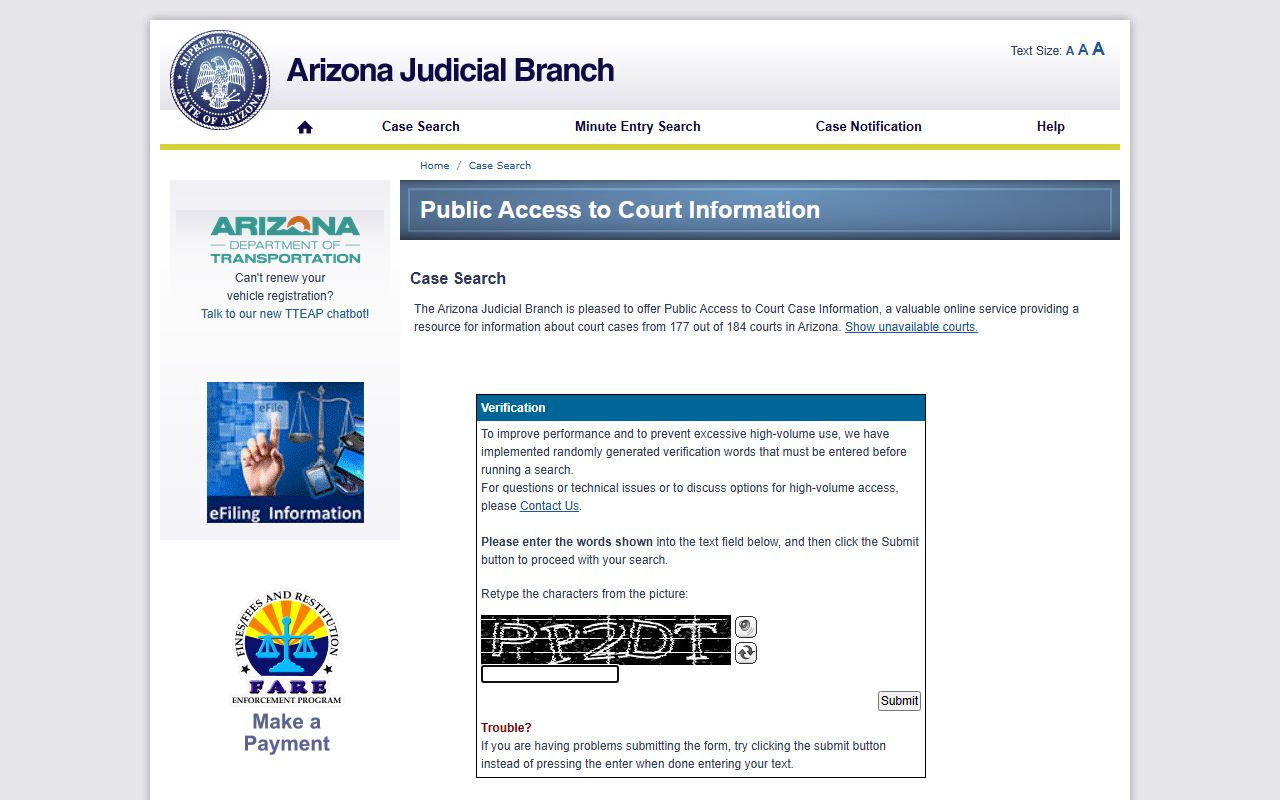
The Arizona Courts Public Access Portal is a free tool that covers Yuma County. You can search court cases from any device with internet access. No account is needed. Enter a name or case number and the system shows matching results. You will see case filing dates, party names, and current case status. Some documents may be viewable on the screen. Others require a request to the clerk office for copies.
To find a case, start by entering the last name of one party. Results show all matching cases in the system. Click on a case to get more details. The portal pulls from the court's own database, so recent filings should appear. However, older records and sealed cases will not show up. Juvenile matters and most adoption files are kept private under Arizona law. If a search turns up nothing, the case may be sealed or the records may be older than what the online system holds.
For records that do not appear online, contact the Yuma County Clerk directly. Staff can search internal systems that have more complete data than the public portal. They can pull copies and mail them to you or have them ready for pickup. You will need to pay copy fees when you get the documents.
Types of Yuma Family Court Records
Divorce records make up a large share of family court files in Yuma. A divorce case starts when one spouse files a petition for dissolution of marriage with the clerk. The case file then grows as both sides add documents. Financial disclosures, property lists, and any agreements get added along the way. The final decree is the court order that ends the marriage. It sets out who gets what property, whether anyone pays spousal support, and the terms for any children.
Child custody records in Arizona now use the terms legal decision-making and parenting time. Legal decision-making covers big choices for the child. This includes school decisions, medical care, and religious training. Parenting time is the schedule that says when each parent has the child. Court files include the parenting plan that either the parties agreed to or the judge ordered. If someone asks to change the plan later, that motion and any new order become part of the record too.
Child support records show how much one parent must pay the other. Orders are based on both parents' incomes and the child's needs. The Arizona Division of Child Support Services works with courts to set up and collect payments. You can reach them at 602-252-4045 or toll-free at 1-800-882-4151. If a parent's job changes, they can ask for a modification. That request and any new order go in the case file.
Paternity cases prove who the legal father is. These files may hold DNA test results, signed acknowledgments, or court orders. Once paternity is set, the court can order support and make custody decisions. Paternity filings are common across all Arizona counties, including Yuma.
Yuma Family Court Record Fees
Copy fees in Yuma County follow the statewide schedule that the Arizona Supreme Court sets. Plain copies cost $0.50 per page. Certified copies add a fee on top of that. The certification makes the document official. You may need certified copies if another court or a government agency asks for proof of a family court order. Banks and employers sometimes want certified copies too.
Filing fees for new family cases went up in late 2024. The Arizona Courts fee schedule now lists Class A fees at $330 and Class B fees at $165. Divorce petitions, custody cases, and paternity matters each fall into one of these categories. Ask the clerk which class applies to your case before you file so you know what to pay.
Fee waivers exist for people who cannot afford court costs. You fill out a form that shows your income, expenses, and debts. The judge looks at your situation and decides if you qualify. If approved, you may have some or all fees waived. This helps low-income residents access the court system. Forms for fee deferral or waiver are at the Yuma County Self-Service Center.
Arizona Family Law Basics for Yuma Residents
Arizona Revised Statutes Title 25 covers all family law in the state. It sets rules for marriage, divorce, custody, support, and paternity. Yuma residents follow the same laws as people in Phoenix or Tucson. There are no special city rules for family court. The main differences between counties come down to court schedules and how many cases the judges handle.
To file for divorce in Yuma, at least one spouse must have lived in Arizona for 90 days. You file in the county where you or your spouse lives. Arizona uses no-fault divorce. You do not have to prove your spouse did anything wrong. You just say the marriage is broken. After the other spouse gets served with papers, the court waits at least 60 days before it can finalize the divorce. This waiting period applies even if both people agree on everything.
Under ARS 25-403.06, both parents have a right to access records about their child's education and health. This applies unless a court order says otherwise. The law makes sure both parents can stay involved in their child's life even after they split up. Schools and doctors must give records to either parent who asks, as long as no court order blocks it.
Note: Statutes can change, so check the official Arizona Legislature website for the current text of any law you need to rely on.
Yuma Family Court Self-Help Resources
The Yuma County Self-Service Center helps people who handle their own family court cases. The center has forms for divorce, custody, support, and other common matters. Staff can point you to the right forms and explain how to file them. They cannot give legal advice or fill out forms for you. That would be practicing law without a license. But they can show you where to find help and what steps to take next.
If you plan to file for divorce in Yuma without a lawyer, start at the self-service center. Get the forms you need. Read the instructions that come with them. Fill out each form as completely as you can. Then bring everything to the clerk office to file. The clerk will check that you have the right forms and that they look complete. You pay the filing fee at that time unless you have a fee waiver on file.
Statewide help is also out there. The AZ Court Help website has guides and videos that walk you through family court step by step. Topics include how to serve papers, what happens at hearings, and how to ask for changes to court orders. These resources are free and do not require you to sign up for anything.
Access Rules for Yuma Family Records
Arizona Supreme Court Rule 123 controls who can see court records. Most family court files are public. Anyone can request copies of divorce decrees, custody orders, and support records. You do not have to be a party to the case. Background check companies, employers, and family members often request these documents.
Some records stay sealed. Adoption files are confidential under state law. Juvenile dependency cases are not open to the public either. If a judge seals a case for other reasons, those documents will not be available. The clerk can tell you if a case is sealed when you ask for records. Sealed cases still exist in the system, but staff cannot give out copies without a court order.
Access to court records does not fall under the general Arizona public records law. That law covers government agencies but not courts. Courts have their own rules. If you have questions about whether you can get a specific type of record, call the Yuma County Clerk of Superior Court and ask.
Contact Yuma Family Court Services
The best way to get family court records in Yuma is to contact the Yuma County Clerk of Superior Court. You can visit the office in person, call, fax, or send email. Here is the contact information:
- Address: 250 W. 2nd Street, Yuma, AZ 85364
- Phone: (928) 817-4210
- Fax: (928) 817-4211
- Email: lfazz@courts.az.gov
- Hours: 8:00 a.m. to 5:00 p.m., Monday through Friday
When you call or visit, bring as much info as you can about the case. The case number is the fastest way to find records. If you do not have it, give the names of both parties and a rough date range. Staff will search for the case and tell you what documents exist. They will let you know the cost before pulling any copies.
For child support matters, you can also reach out to the Arizona Division of Child Support Services. Call 602-252-4045 or use the toll-free line at 1-800-882-4151. The office is open Monday through Friday from 7:00 a.m. to 5:30 p.m. Staff can answer questions about payment history, modifications, and enforcement actions.
Nearby Arizona Counties
Yuma is the only major city in Yuma County. All family cases from the City of Yuma and smaller towns in the county go through the same Superior Court. There is no city-level family court for any community in Arizona. If you need records from outside Yuma County, you must contact the court in that county directly.
La Paz County sits north of Yuma County. Its Superior Court is in Parker. Maricopa County, home to Phoenix, is northeast. It has the largest family court system in the state with multiple regional centers. Pima County lies to the east. Each county keeps its own records. A case filed in one county stays there unless it gets transferred for a specific legal reason.